GHK-Cu skin findings
The most useful cosmetic result has a named outcome. Calling every outcome “younger” is where my suspicion starts.
The collagen comparison
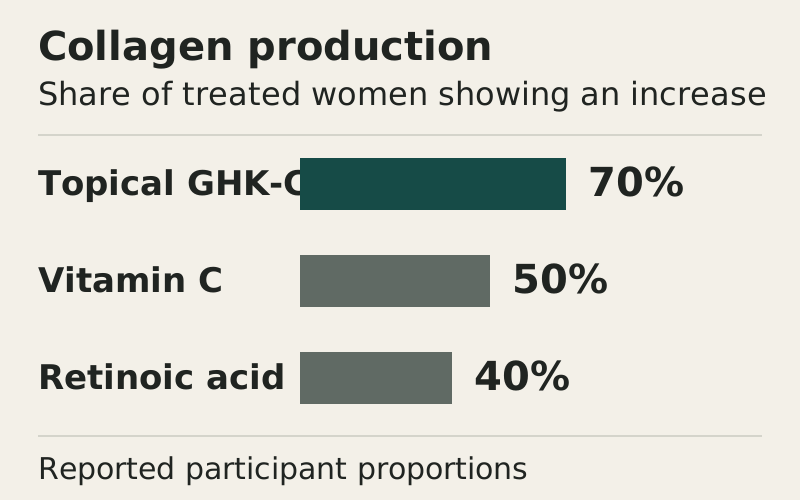
There is a comparison in the GHK-Cu literature that sounds wonderfully decisive when stripped down to its percentages. The skin-regeneration review reports increased collagen production in 70% of women treated with topical GHK-Cu, versus 50% for vitamin C and 40% for retinoic acid. Those figures practically arrange their own podium. They are compact, easy to repeat and apparently ready to settle a contest.
Read as written, the result concerns the proportion of treated women whose collagen production increased. It does not say collagen production rose by 70%. Those interpretations would describe very different things. Nor does the reported comparison supply a percentage improvement in visible wrinkles. The outcome named here is collagen production.
I will defend this observation at its actual size. It is a favourable finding for topical GHK-Cu in the reviewed research. Converting it into a general ranking of cosmetic approaches would ask this particular endpoint to judge everything else that someone might care about.
Fine lines, laxity and wrinkle depth
The same review describes placebo-controlled improvements in skin laxity, clarity, fine lines, wrinkle depth and density. These observations bring the discussion closer to appearance than a cell-culture finding does. They also give “better skin” several possible meanings. A particular change in fine lines is a description I can picture.
The later anti-wrinkle review discusses the collagen-synthesis comparison alongside the problem of getting GHK through skin. Delivery is where my optimism has to do some work. An ingredient's name alone tells me too little about the preparation being discussed. The connection between the material applied and the outcome measured needs to remain visible.
A review can gather an appealing body of work, but repeated appearances of a result in reviews do not create additional trials. That multiplication irritates me. The later discussion can improve the explanation of a finding without adding another group of participants who experienced it.
Collagen in cultured cells
The fibroblast experiment found increased collagen synthesis without an increase in cell number. It helps explain why collagen features so prominently in this subject. Its setting was human cells in culture, and the result wins me over within that setting. The cells changed their activity. A reader can appreciate that finding without supplying a visible facial result that the experiment never measured.
The tissue-remodeling review also describes collagen, elastin and matrix-regulating proteins across human and animal research. “Remodeling” is useful language here because the reviewed biology involves more than producing collagen. The same skin-regeneration review also reports synthesis of dermatan sulfate, chondroitin sulfate and decorin. That is a busier biological picture than the familiar image of pouring extra collagen into skin. As an explanation, I favour this richer account over the familiar shorthand of simply adding more material.
Accounts of firmer skin
Community descriptions of firmer skin and softer lines are anecdotal accounts, not clinical evidence. They tell us how an appearance was perceived. I take that kind of satisfaction seriously as an experience while reserving a different judgement for a measured effect. Separately, the clinical findings on laxity and fine lines collected in the review offer observations from controlled research. The resemblance between the descriptions is tempting; the records behind them remain different.
The question that remains most interesting to me is durability: how a particular visible improvement holds up over time. The endpoints described here cannot, by themselves, settle a claim of permanent rejuvenation. The delivery page returns to something more immediate and concrete—what happened when copper was measured on its passage through prepared skin.